


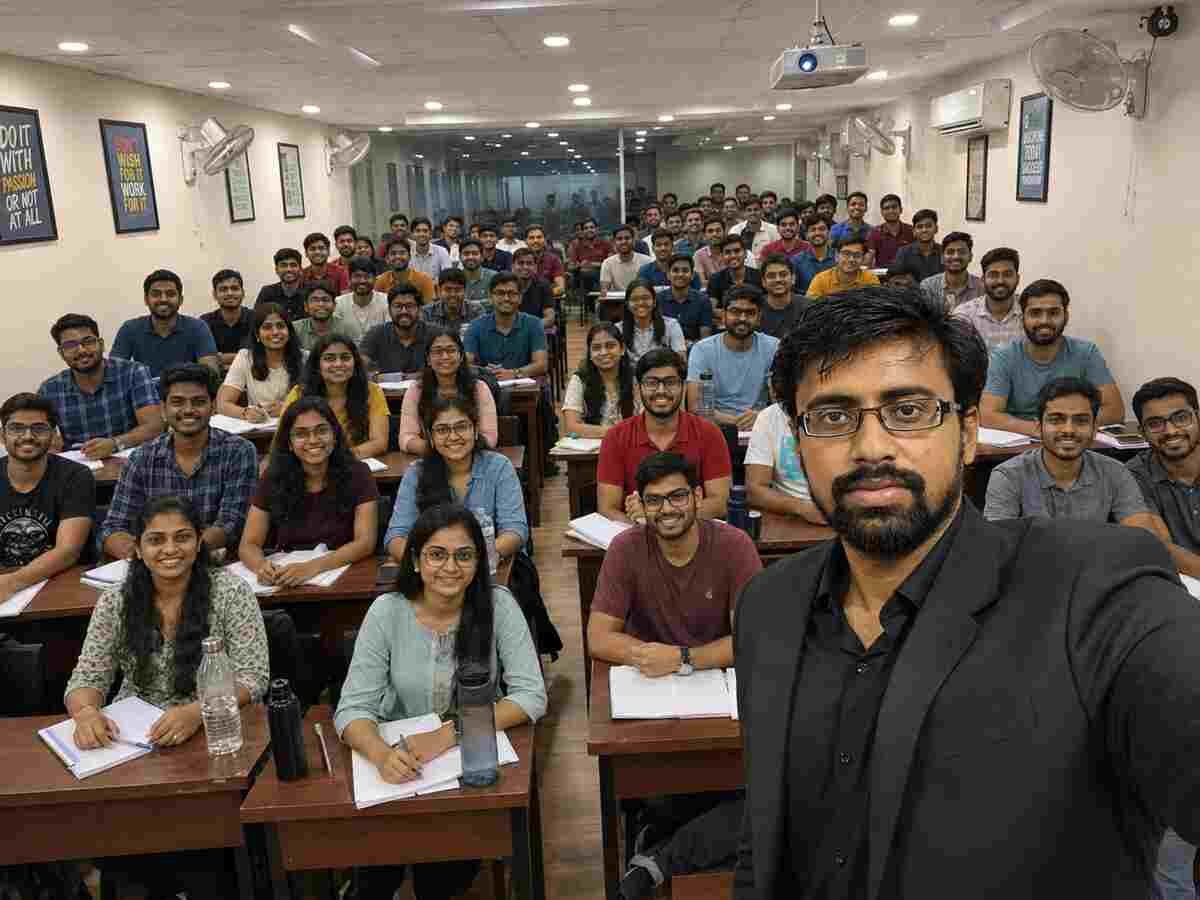
For many students, the most difficult part of education is not studying itself. The real difficulty begins when they have to decide what to study, which examination to prepare for, which career path to choose, and how to connect their academic strengths with future opportunities. In a time when students are surrounded by endless information but often lack clear direction, the need for structured academic and career guidance has become more important than ever. This is the area where Dr. Sourav Sir’s Classes is developing a distinctive identity—by combining subject teaching with strategic mentoring, career awareness, and long-term academic planning.
The modern student faces a very different educational environment from that of previous generations. Earlier, career paths were comparatively straightforward. A student completed school, entered college, earned a degree, and then pursued a limited set of professional opportunities. Today, the situation is far more complex. Students can choose from conventional university programmes, interdisciplinary degrees, research careers, government services, competitive examinations, international admissions, professional certifications, data-driven careers, and emerging fields that did not exist a few years ago.
While this increase in opportunity is positive, it also creates uncertainty. Many students begin preparing for examinations simply because their friends are doing the same. Some select subjects without understanding the careers associated with them. Others spend years preparing without having a realistic strategy or alternative academic plan. Dr. Sourav Sir’s Classes addresses this growing problem by helping learners view education not as a collection of unrelated examinations, but as a connected journey towards a meaningful academic and professional destination.
At the core of this approach is the idea that career planning should begin with understanding the student. Academic marks alone cannot define a learner’s future. Interests, analytical ability, communication skills, consistency, temperament, subject preferences, long-term ambitions, and personal circumstances all influence career decisions. Two students with similar marks may therefore require completely different academic paths.
Instead of encouraging students to follow popular choices blindly, the institution places emphasis on identifying suitable opportunities based on individual strengths and goals. A student interested in mathematics may discover pathways through statistics, economics, data science, research, actuarial studies, or quantitative finance. A student with an interest in social sciences may consider higher education, research, public policy, civil services, teaching, development studies, or competitive examinations. The purpose of guidance is to make students aware of the possibilities before asking them to make important decisions.
This approach is especially useful because many students receive very little formal career counseling in school or college. They may know the name of a degree but not understand what comes after it. They may hear about an entrance examination without knowing its eligibility criteria, syllabus, level of competition, or career prospects. As a result, students often make decisions using incomplete information.
Dr. Sourav Sir’s Classes attempts to bridge this information gap through continuous academic interaction and mentoring. Students are guided to understand the relationship between their present course, future entrance examinations, postgraduate opportunities, research possibilities, and employment options. Such guidance can help them avoid unnecessary changes of direction and make better use of their academic years.
Another important aspect of the institution’s approach is the emphasis on creating backup pathways. Competitive examinations are uncertain by nature. Even a capable student may not succeed in a particular attempt because of competition, examination pressure, changing cut-offs, or an unexpected performance issue. Therefore, building a future around only one examination can create enormous stress.
A more responsible preparation strategy includes alternatives.
Students can be encouraged to identify multiple suitable institutions, examinations, degrees, or career routes instead of becoming dependent on a single result. This does not reduce ambition. On the contrary, it makes ambition more sustainable. A learner can pursue a primary goal while remaining aware of other strong academic options.
This planning mindset can significantly reduce the fear surrounding competitive examinations. When students know that one unsuccessful result will not destroy their entire future, they often prepare with greater confidence and emotional stability.
Dr. Sourav Sir’s Classes also recognizes that academic performance and career success require different but interconnected skills. A student may have excellent subject knowledge but struggle during interviews. Another may perform well in written examinations but find it difficult to communicate ideas clearly. Some students need help with analytical writing, while others require guidance in problem-solving speed, presentation, or academic planning.
For this reason, learning cannot remain limited to syllabus completion. Students increasingly need to develop transferable skills that can support them across different stages of education and employment.
Critical thinking, time management, logical reasoning, communication, decision-making, self-discipline, and the ability to learn independently are becoming central to long-term success. These skills are valuable whether a student eventually enters research, corporate employment, government service, higher education, teaching, or entrepreneurship.
The teaching environment at Dr. Sourav Sir’s Classes therefore aims to create learners who can adapt rather than students who can only reproduce memorized material.
This adaptability is particularly important because the nature of careers is changing rapidly. Technology is transforming traditional professions, interdisciplinary careers are becoming more common, and employers increasingly value the ability to solve problems rather than simply possess a degree. Students graduating today may eventually work in roles that are very different from the subjects they originally studied.
A student who develops strong analytical and learning abilities can respond to such changes more successfully.
The institution’s emphasis on conceptual clarity supports this broader objective. When students understand the logic behind a subject, they become better equipped to apply knowledge in unfamiliar contexts. This is particularly valuable in mathematics, economics, statistics, science, research methodology, and other analytical disciplines where the ability to interpret and apply concepts is often more important than memorizing information.
Another major change in modern education is the growing importance of interdisciplinary learning. Boundaries between subjects are becoming less rigid. Economics increasingly uses mathematics and data analysis. Biology interacts with statistics and computation. Social science research requires quantitative methods. Business decisions rely on analytics. Artificial intelligence is influencing almost every field.
Students therefore need to understand not only their primary subject but also how it connects with other disciplines.
Dr. Sourav Sir’s Classes can play an important role in helping students recognize these connections. A learner preparing for a particular examination may also discover skills that can strengthen future postgraduate studies, research, or employment opportunities. This makes coaching more valuable because it becomes part of a larger academic development process rather than an isolated short-term activity.
The hybrid learning model of the institution further supports this philosophy. Online education allows students from different geographical locations to access specialized guidance, while offline interaction offers the advantages of direct classroom engagement. Recorded academic support can help with revision, while live sessions allow immediate clarification and discussion.
This flexibility is particularly significant for learners who are simultaneously attending school, university, employment, internships, or other courses. Education has to adapt to the realities of students’ lives rather than forcing every student into a single rigid schedule.
The digital expansion of education has also created greater equality of access. Previously, specialized coaching was often concentrated in a few metropolitan areas. Students from smaller towns had to relocate or accept limited local options. Online teaching has reduced this geographical barrier and opened access to students who might otherwise remain disconnected from specialized academic support.
However, access to online content alone is not enough. The internet already contains an enormous volume of educational material. What students need is structure.
Without structure, learners can move endlessly from one video to another, download hundreds of notes, and still remain unsure about what they should study next. Dr. Sourav Sir’s Classes seeks to provide this structure through guided preparation, study planning, evaluation, and regular academic interaction.
The role of the teacher in such an environment changes significantly. The teacher is no longer simply the source of information. The teacher becomes a guide who helps students organize information, understand priorities, evaluate progress, and make better academic decisions.
This shift from lecturer to mentor is one of the most important developments in contemporary education.
Under the leadership and academic guidance of Dr. Sourav Das, the institution follows a mentoring-oriented approach in which the educational relationship can continue beyond the immediate classroom topic. Students can seek direction regarding examination preparation, higher studies, research opportunities, subject choices, and career decisions.
Such mentorship can be particularly important during transitional stages. Moving from school to university, graduation to postgraduate education, or postgraduate study to research and employment can create uncertainty. Students often need someone who can explain what comes next and help them evaluate their available options objectively.
Parents also face similar uncertainty. Many parents want to support their children but may not be familiar with newer courses, entrance examinations, changing university systems, or emerging career opportunities. An institution that communicates clearly with students and families can therefore become an important source of informed educational guidance.
This is another area where the concept of coaching is expanding. Modern education requires institutions that can function as academic navigation systems, helping learners interpret the increasingly complex world of higher education and careers.
The true value of such guidance may not always be visible immediately in examination marks. Sometimes its impact appears when a student chooses a more suitable course, avoids an inappropriate career decision, discovers a new academic opportunity, or develops the confidence to pursue a challenging goal.
These decisions can influence decades of a person’s professional life.
Therefore, the success of an educational institution should not be measured only by how many students pass an examination. It should also be measured by how effectively students learn to make informed decisions about their own futures.
Dr. Sourav Sir’s Classes is increasingly positioning itself within this broader educational role. By combining academic instruction, examination strategy, personalized mentoring, technology-enabled learning, and career awareness, the institution seeks to support students from their immediate academic challenges to their longer-term ambitions.
The future of education will require more than knowledgeable teachers. It will require mentors who can understand students as individuals, institutions that can adapt to changing career landscapes, and learning systems that connect academic preparation with real-world possibilities.
When students understand not only what they are studying but also why they are studying it and where it can take them, education gains a new purpose. Preparation becomes more focused, career decisions become more informed, and students begin to take greater ownership of their futures.
That transition—from academic confusion to career clarity—is becoming one of the most important educational needs of the present generation. Through its evolving model of teaching and mentorship, Dr. Sourav Sir’s Classes continues to work towards creating learners who are prepared not simply for their next examination, but for the many decisions, opportunities, and challenges that will shape their lives beyond the classroom.
For more details: https://www.souravsirclasses.com/


