


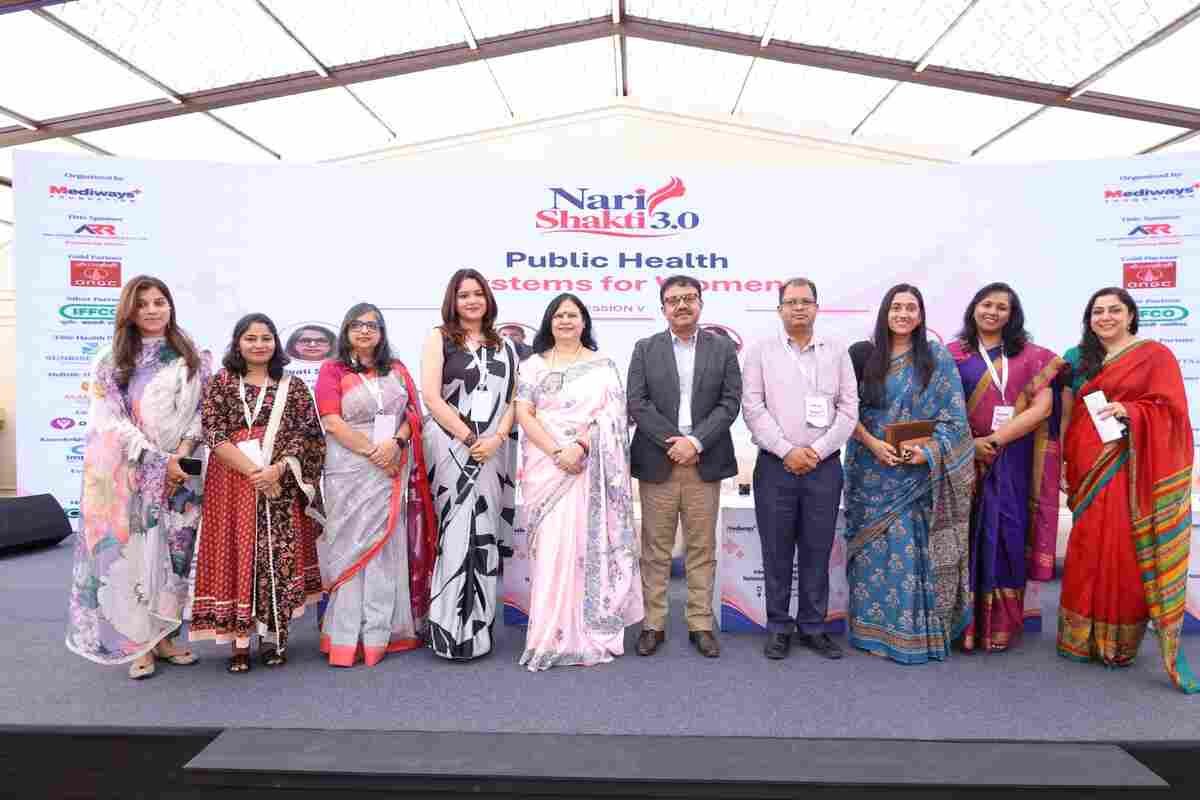
Mediways Health Foundation’s Nari Shakti 3.0 continued into its second day at The Leela Palace, New Delhi, with conversations turning towards public health systems, preventive care and the need to strengthen women’s healthcare beyond awareness campaigns. The session brought together experts from healthcare, public health, CSR and community development to examine how India can build population-level health systems that address women’s needs across different stages of life.
The day’s programme was led by Ms Pragya Sharma, Director, Maharishi Ayurveda, as Chief Guest, who spoke about the importance of prevention and early attention to women’s health. Drawing from the preventive principles of Ayurveda, she highlighted the need to combine traditional health wisdom with modern medicine and technology to create a more holistic and accessible approach to women’s wellbeing.
The keynote address by Dr Meera Khanna- Trustee & President, The Guild of Service, further set the context for the day’s conversations.
“Women are not absent from our health system; too often, they are simply the last to be considered. A truly universal health system must be designed around the woman who has the least money, mobility, family support or ability to ask for help. If our systems can reach her with dignity, continuity and care, they can work for everyone. We should not design for the many and hope the last woman is reached; we should begin with her and build outward.”, said Dr Meera.
Taking the discussion forward, Session V, “Public Health Systems for Women” examined how India can move from awareness-led interventions towards stronger, population-level public health systems for women, with a particular focus on prevention, early detection, treatment and follow-up.
Opening the session, the moderator Monieka Khera highlighted that women’s health must be viewed as a life-course issue, extending from adolescence and reproductive health to mental wellbeing, menopause and healthy ageing. The discussion also explored what it would take to take healthcare beyond awareness campaigns and closer to women in their homes and communities, while building stronger systems for primary care, screening and continuity of treatment.
Dr. Priya John, General Secretary, CMAI, brought the conversation to the ground level, pointing out that while large systemic gaps require institutional action, smaller barriers can often determine whether a woman actually receives care.
“The big systems will take time to build, but we can start by addressing the small gaps around us. Sometimes it means simply reaching a woman where she is and ensuring that her family understands that her health matters too.”
Sanchita Vaish, Company Secretary and CSR Lead, Baker Hughes, shifted the focus from screening numbers to actual health outcomes.
“Screening is only the beginning. We need to ask what happened after those women were screened; did they receive a diagnosis, treatment and follow-up? That is where we move from an event to an actual health outcome.”
Mittal Gohil, Executive Director, Desai Foundation Trust, highlighted the larger development implications of women’s health, particularly in underserved communities.
“Women’s health is not just a healthcare issue; it is fundamentally a development issue. The infrastructure may exist, but unless we get the execution right and stay with a woman through treatment and follow-up, we haven’t really solved the problem.”
Lt Col (Dr) Shweta Bhardwaj, MBBS, DNB, MNAMS, spoke about the social and family-level barriers that continue to influence women’s health-seeking behaviour.
“In many families, a woman’s health still comes after everyone else’s needs. Awareness is often not the problem; circumstances are. We have to create an environment where women have the support and importance they need to actually seek care.”
Sujeet Ranjan, PhD, MPH, CEO, United Way Delhi, brought the conversation back to the role of prevention and primary healthcare in strengthening public health outcomes.
“Prevention has to remain at the heart of public health. We need to look at how we prevent illness, promote healthier lives and improve health-seeking behaviour, particularly where access to care is still shaped by geography and circumstance.”
Prabhakant Jain, Head CSR, DS Group, gave insights on how CSR can play a much larger role in women’s health than simply funding awareness campaigns.
“If we can support stronger primary healthcare, better access and systems that generate meaningful local data, we can create interventions that are not only wider in reach but also more sustainable and responsive to what communities actually need.”
The discussion collectively highlighted that improving women’s health outcomes will require more than awareness campaigns or isolated screening drives. From reaching women in underserved communities and involving families in healthcare decisions to ensuring diagnosis, treatment and follow-up, the panel emphasised the need for continuity, community trust and stronger last-mile delivery.
The session reinforced the larger vision of Nari Shakti 3.0 that building a healthier India requires women’s health to be treated not as a standalone healthcare concern, but as a critical part of public health, social development and the country’s broader journey towards a healthier and more inclusive future.


