


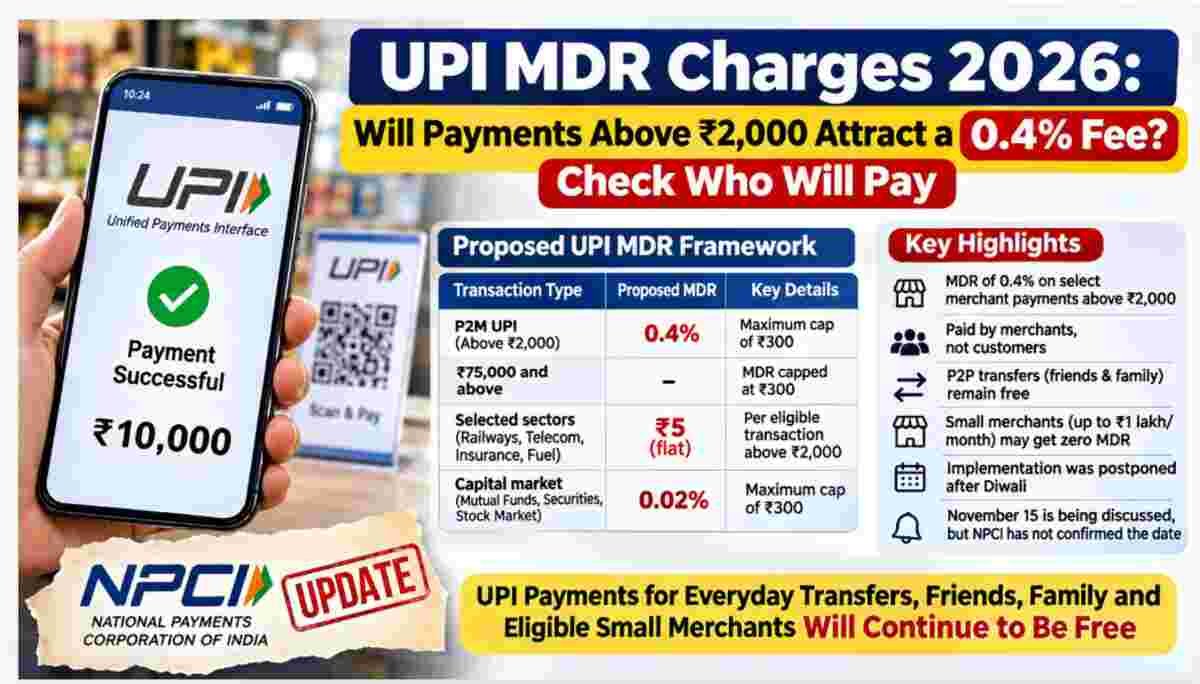
The proposed Merchant Discount Rate (MDR) on select Unified Payments Interface (UPI) transactions is back in focus after the festive season. The National Payments Corporation of India (NPCI) had earlier postponed the implementation of the proposed charges until after Diwali, and merchants are now waiting for an official announcement regarding the revised rollout date.
According to recent reports, November 15 is being discussed as a possible date for an update. However, NPCI has not officially confirmed November 15 as the implementation date. The proposed framework could introduce a 0.4% Merchant Discount Rate on eligible Person-to-Merchant (P2M) UPI transactions exceeding ₹2,000.
The proposed changes have raised questions among shopkeepers, businesses and digital payment users about who will pay the charges, which transactions will be affected and whether everyday UPI payments will remain free.
What Is the Latest Update on UPI MDR Charges?
NPCI had initially scheduled the implementation of the revised MDR framework for October 15, 2026. However, on October 13, the organisation announced that the implementation of MDR on select P2M UPI transactions would be postponed until immediately after Diwali.
The decision was taken to avoid placing additional financial pressure on merchants and customers during the festive shopping season.
NPCI stated that the revised implementation date would be announced separately. As of November 12, an officially confirmed implementation date is still awaited.
What Is the Proposed MDR on UPI Transactions?
Merchant Discount Rate, commonly known as MDR, is a processing fee associated with digital payments. It is generally paid by merchants to the banks and payment service providers involved in processing transactions.
Under the proposed NPCI framework, eligible Person-to-Merchant UPI payments exceeding ₹2,000 would attract an MDR of 0.4%.
Here are the key proposed provisions:
1. MDR of 0.4% on eligible payments
Select P2M UPI transactions above ₹2,000 would attract a merchant-side charge of 0.4%.
2. Maximum MDR cap of ₹300
The proposed framework sets a maximum charge of ₹300 per transaction for payments of ₹75,000 and above.
For example:
- UPI payment of ₹5,000: MDR of ₹20.
- UPI payment of ₹10,000: MDR of ₹40.
- UPI payment of ₹50,000: MDR of ₹200.
- UPI payment of ₹75,000: MDR of ₹300.
- UPI payment of ₹1 lakh: MDR remains capped at ₹300.
3. Special rates for selected sectors
Certain categories, including railways, telecom, insurance and fuel-related payments, have been assigned a proposed flat MDR of ₹5 per eligible transaction exceeding ₹2,000.
4. Capital market transactions
Eligible payments relating to mutual funds, securities and stock market transactions would attract a proposed MDR of 0.02%, subject to a maximum cap of ₹300 per transaction.
Who Will Pay the UPI MDR Charges: Customers or Merchants?
One of the biggest concerns surrounding the proposed UPI MDR framework is whether ordinary customers will have to pay extra when making digital payments.
According to the proposed rules, the MDR is a merchant-side charge. It is payable by the eligible merchant receiving the payment rather than the customer making the transaction.
The Ministry of Finance has also indicated that banks should ensure merchants do not pass these charges on to customers.
Therefore, customers are not supposed to face an additional UPI MDR charge under this framework.
Will Sending Money to Friends and Family Remain Free?
Yes. Person-to-Person (P2P) UPI transactions are outside the proposed MDR framework.
This means the following transactions will continue to remain outside these proposed merchant charges:
- Sending money to friends and family.
- Transferring money between personal bank accounts.
- Splitting restaurant or shopping bills.
- Sending money to another individual through UPI.
The proposed MDR primarily concerns eligible Person-to-Merchant payments rather than ordinary transfers between individuals.
Will Small Shopkeepers and Local Merchants Be Affected?
The proposed framework also provides relief to certain small merchants.
According to NPCI’s published MDR FAQs, merchants classified under the Person-to-Person Merchant (P2PM) category are eligible for zero MDR protections, subject to the applicable classification and collection criteria.
Small merchants receiving up to ₹1 lakh per month through eligible UPI collections may qualify for this exemption.
This means that receiving an individual payment above ₹2,000 does not automatically mean that every small shopkeeper will have to pay MDR. Merchant classification and eligibility conditions are important.
Why Did NPCI Postpone the UPI MDR Implementation?
The original implementation date was October 15, 2026. However, NPCI postponed the rollout on October 13, citing the festive season.
Diwali and the surrounding shopping period generally bring increased retail activity and digital transactions across India.
Introducing additional payment-processing costs during this period could have increased financial pressure on merchants.
NPCI’s decision provided additional time for payment companies, banks and merchants to prepare for the proposed changes.
When Will the New UPI MDR Rules Come Into Effect?
The revised implementation date remains the biggest unanswered question.
Although November 15 has been discussed in reports as a possible date for an announcement, there is no official confirmation that the new charges will start on that day.
Merchants, payment companies and UPI users are awaiting a formal notification from NPCI explaining the final implementation timeline and operational requirements.
Until an official notification is issued, the proposed MDR rates should not be treated as charges that have already come into effect.
Conclusion: Will UPI Payments Become Costlier for Common People?
The proposed UPI MDR framework represents a potential change in India’s digital payment ecosystem, particularly for eligible merchant transactions exceeding ₹2,000.
However, the proposed charges are designed to be paid by eligible merchants rather than ordinary customers. Person-to-person transfers and qualifying exempt merchant categories are also outside the applicable MDR charges.
For now, the key development to watch is NPCI’s official announcement regarding the revised implementation date.
Merchants should review their payment category and applicable MDR conditions, while customers can continue to distinguish between personal UPI transfers and merchant payments under the proposed framework.


