


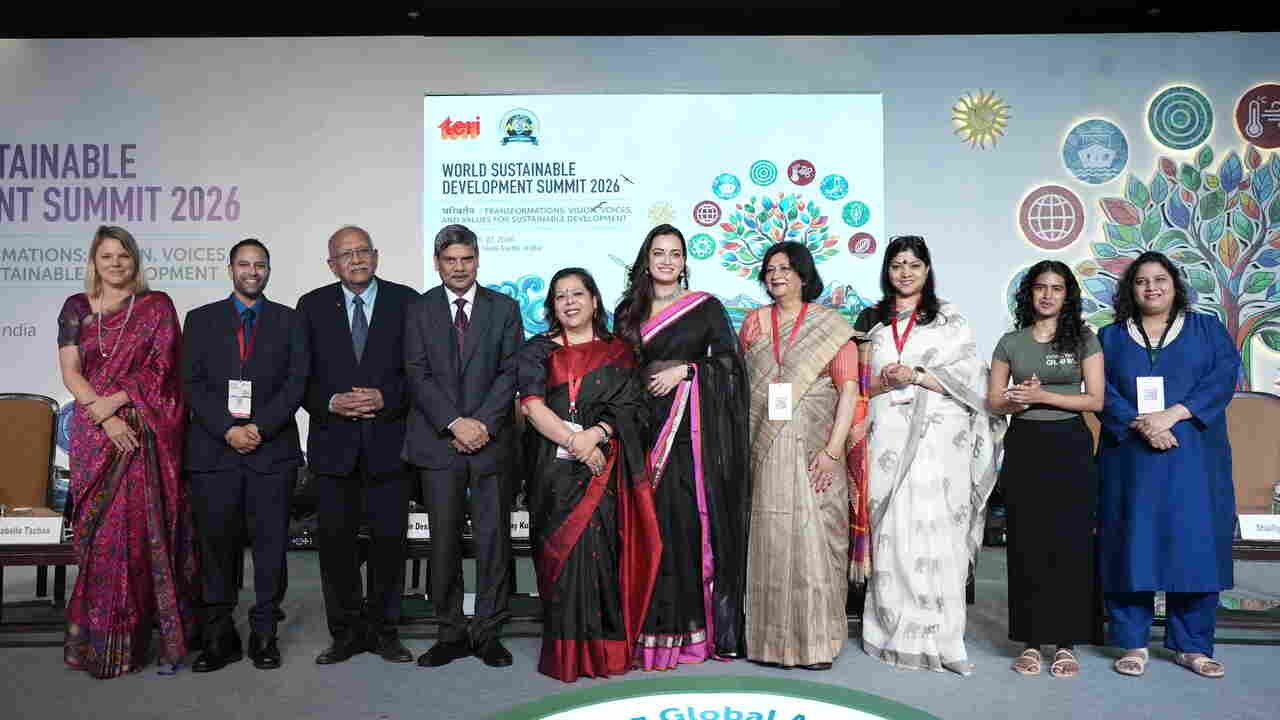
Valedictory Session Unites Government, UN, Industry, and Youth for a Shared Climate Agenda
New Delhi : The final day of the World Sustainable Development Summit 2026 (WSDS 2026), organised by The Energy and Resources Institute (TERI), concluded with renewed commitment and collective resolve. The Valedictory Session, titled “Reflections, Resurgence, and Resolve for Our Common Future,” brought together leaders from government, multilateral institutions, industry, academia, and civil society at the iconic Durbar Hall.
The closing session reinforced WSDS as more than a convening platform — it emerged as a catalyst for accountable, implementation-driven climate action during what many termed the defining “climate decade.”
India’s Climate Path: Growth with Responsibility
Mr Tanmay Kumar, Secretary, Ministry of Environment, Forest and Climate Change (MoEFCC), Government of India, emphasized that climate change now intersects with development, governance, and national security.
He highlighted India’s science-based, equity-driven model — balancing economic growth, poverty eradication, urbanisation, industrialisation, and decarbonisation simultaneously. With per capita emissions at approximately 2 tonnes annually, India has surpassed its 2030 target of 50% non-fossil installed power capacity five years ahead of schedule, reaching over 51% in June 2025.
“Clean energy is not charity,” he noted. “It is competitiveness driven by economics.”
Climate Justice, Gender, and Youth Leadership Take Centre Stage
Ms Dia Mirza, Goodwill Ambassador at the United Nations Environment Programme, underlined that climate change disproportionately impacts women and girls, despite their central role in food systems and community resilience. Sustainability, she stressed, is now foundational to survival, dignity, and peace.
Ms Isabelle Tschan, Deputy Resident Representative at the United Nations Development Programme, highlighted India’s demographic advantage, with nearly 65% of its population under 35. She announced collaboration between UNDP, MoEFCC, and TERI to launch the Mission LiFE Youth Ambassadors programme, placing youth leadership at the heart of sustainability practice.
Development and Climate: A Unified Economic Agenda
Ms Vaishali Nigam Sinha, Co-Founder & Chairperson (Sustainability), ReNew, asserted that development and climate action are no longer parallel agendas but one unified economic imperative.
“The global South is no longer asking for permission; it is offering solutions,” she said, adding that implementation between summits defines true progress.
Dr Ash Pachauri of the POP (Protect Our Planet) Movement reflected on 25 years of WSDS, calling the milestone both a celebration of legacy and a reminder of shared responsibility for the future.
From Individual Action to Global Movement
Ms Prachi Shevgaonkar, Founder of Cool The Globe, shared her journey from a concerned student to leading a global citizen-driven sustainability initiative active in over 150 countries — demonstrating how small, daily climate actions can scale into collective transformation.
Mr Nitin Desai, Chairman, TERI, reiterated that sustainable development demands collaborative learning across governments, businesses, researchers, and communities.
Dr Vibha Dhawan, Director General, TERI, stressed that partnerships are no longer optional but essential in a resource-constrained world.
Dr Shailly Kedia, Curator of WSDS and Director at TERI, highlighted record participation at WSDS 2026, with 2,381 delegates, 10 plenaries, 14 thematic tracks, and the defining Him-CONNECT segment focusing on Himalayan resilience and innovation.
Key Launches: Knowledge, Youth, and Action
The Valedictory Session featured several significant launches:
- The 18th edition of Vasundhara – “Climate Capital”, the student-led sustainability magazine of TERI School of Advanced Studies.
- The Act4Earth Manifesto, outlining collective climate commitments emerging from the Summit.
- The launch of The Politics of Sustainable Development authored by Mr Nitin Desai.
- Presentation of the WSDS 2026 Summit Report by Dr Shailly Kedia, summarising key outcomes from three days of deliberations.
Parallel to the session, TerraZone — WSDS’s sustainability expo — showcased innovations across clean technology, circular economy models, and nature-based solutions. Him-CONNECT, curated by MoEFCC, brought Himalayan ecosystems and community-led resilience into the global sustainability narrative.
A Mandate for the Climate Decade
As WSDS 2026 drew to a close, one message resonated clearly: the climate decade demands convergence — of finance and fairness, ambition and accountability, innovation and inclusion.
With strengthened partnerships and renewed resolve, WSDS reaffirmed its position as a global platform advancing transformative climate action for people, planet, and prosperity.


